
Ever wished you could trade like a pro—without spending years deciphering complex charts and strategies? In today’s dynamic financial world, Copy Trading has emerged as a revolutionary solution, democratizing access to expert-level trading. It’s a modern, automated method where you can seamlessly replicate the real-time trades of proven, experienced traders.
This comprehensive guide will demystify what Copy Trading is, explain how Copy Trading works with practical examples, delve into its compelling pros and cons, and crucially, address its legal standing in India for 2025 – all presented in clear, actionable language for aspiring investors.
1. What Exactly Is Copy Trading? A Simple Definition
Copy Trading is an innovative automated strategy that allows you to directly replicate another trader’s positions in your own brokerage account. Think of it as investing your money, but allowing seasoned professionals to make the actual buying and selling decisions.
- The Core Idea: If your chosen expert buys Bitcoin or sells Tesla stock, your account does the same—instantly and proportionally. This real-time execution ensures you participate in their market moves without any manual effort.
- In Short: “You invest your capital, but the intricate trading decisions are handled by professional traders.”
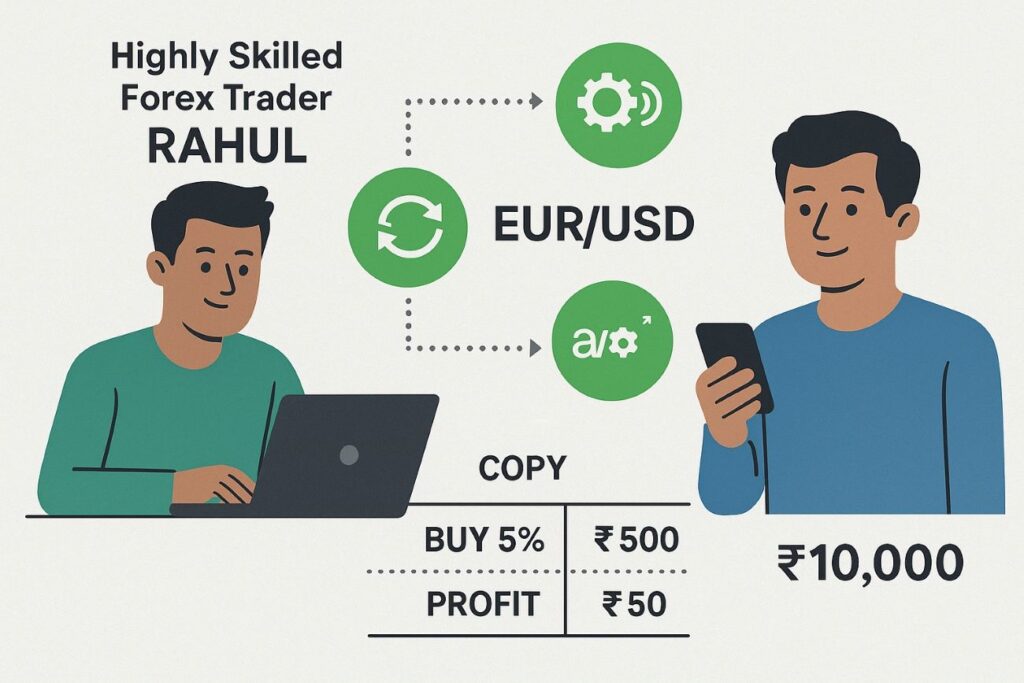
Real-Life Example:
Suppose “Rahul” is a highly skilled forex trader with a proven track record on a platform like eToro or DupliTrade. You decide to copy Rahul with ₹10,000. When Rahul opens a buy position for EUR/USD using 5% of his capital, your account automatically opens a proportionate buy position for EUR/USD using 5% of your ₹10,000 (i.e., ₹500). When he closes it for a profit, your account closes it too, booking a proportionate gain. This entire process is fully automated from start to finish.
2. How Copy Trading Works: The Mechanism Behind Automated Success
The true power of Copy Trading lies in its sophisticated yet user-friendly mechanism, facilitating automated replication of expert trades.
- Connecting Your Account: You start by selecting a top-performing trader from the platform’s leaderboard, based on their historical performance, risk score, and asset focus (e.g., crypto copy trading, forex copy trading).
- Allocating Capital: You then allocate a portion of your investment capital to copy this trader. This is crucial for risk management as you decide how much you’re willing to invest in a particular expert.
- Proportional Execution: This is the key. When the expert opens a trade, the system automatically opens the exact same trade in your account, but proportionally sized to your allocated capital. If the expert uses 2% of their €50,000 portfolio for a trade, your €1,000 allocated capital will use 2% (€20) for the same trade. This ensures your risk exposure aligns with the expert’s, scaled to your investment.
Real-Time Automation: All trade entries, exits, stop-losses, and take-profits are executed automatically and simultaneously in your account as they are in the expert’s. This eliminates emotional trading and ensures precision, making it an ideal passive income trading strategy.
Contact Us for Copy Trading Inquiries
3. The Benefits of Copy Trading: Why Investors Are Choosing This Path
Copy trading for beginners offers numerous advantages that appeal to both novice and experienced investors alike:
- Access to Expertise: Instantly leverage the knowledge, experience, and strategies of professional traders without needing years of market study or complex chart analysis.
- Time-Saving: Say goodbye to endless hours of market research, technical analysis, and constant monitoring. Copy trading is a true passive investment
- Diversification: Easily diversify your portfolio by copying multiple traders who specialize in different asset classes (e.g., stocks, forex, crypto, commodities) or employ varied strategies.
- Learning Opportunity: Observe the trading styles and risk management strategies of successful traders in real-time, gaining valuable insights for your own future trading.
- Emotional Detachment: Automated execution removes the psychological biases and emotional decision-making that often lead to losses for individual traders.
- Potential for Passive Income: With the right selection of traders, copy trading can generate consistent returns, contributing significantly to your passive income streams.
4. Understanding the Risks: What You Need to Consider Before Copying
While highly attractive, Copy Trading is not without its risks. It’s vital to approach it with a clear understanding of these potential drawbacks:
- Market Risk: All trading involves risk. The value of your investments can go down as well as up, and past performance is not indicative of future results.
- Trader Risk: You are relying on the expertise of another individual. A copied trader might make poor decisions, experience a losing streak, or even abandon their strategy, impacting your capital. Always check their long-term performance and drawdown statistics.
- Platform Risk: Ensure you choose a reputable and regulated Copy Trading platform to protect your funds and personal information.
- Lack of Control: While you can stop copying a trader at any time, you have no direct control over individual trade decisions once copying is active.
- Over-Diversification/Under-Diversification: Copying too many traders haphazardly can lead to an unfocused portfolio, while copying too few can concentrate risk.
- Proportionality Risks: While beneficial, if an expert makes an exceptionally large trade relative to their capital, your proportional trade might still be larger than you’d prefer given your overall account size.
5. Is Copy Trading Legal in India (2025)?
This is a critical question for Indian investors, and the landscape can be nuanced. As of 2025:
- No Explicit Ban: There is no specific law in India that explicitly bans Copy Trading.
- Regulatory Scrutiny: However, the Securities and Exchange Board of India (SEBI) often views activities that resemble portfolio management or investment advisory without proper licenses with scrutiny.
- Platform Jurisdiction: The legality often hinges on the regulation of the Copy Trading platform Many popular platforms are regulated internationally (e.g., by CySEC in Cyprus, FCA in the UK), but not directly by SEBI.
- Forex and Crypto: Trading in unregulated forex pairs or certain cryptocurrencies through foreign platforms can carry additional risks and may fall into a grey area concerning FEMA (Foreign Exchange Management Act) regulations for Indian residents.
- Recommendation: Indian investors should exercise extreme caution, conduct thorough due diligence on both the platform and the traders, and ideally consult with a financial advisor familiar with Indian regulations before engaging in Copy Trading. Choose platforms that are transparent about their regulatory status and offer robust client protection.
Conclusion
Copy Trading presents an exciting and accessible avenue for individuals looking to participate in financial markets, especially those seeking a passive income strategy or insights into expert trading. By allowing you to automatically replicate the moves of professional traders, it significantly lowers the barrier to entry and saves valuable time.
However, like any investment, it comes with inherent risks. Understanding what Copy Trading is, how it works, and carefully evaluating both its benefits and potential drawbacks is paramount. By choosing reputable platforms and exercising due diligence, you can harness the power of automated trading and potentially enhance your investment portfolio in 2025 and beyond.
Let's Automate Growth
Rapid Algo Ai, India’s leading algorithmic trading and copy trading automation platform — empowering traders, investors, and institutions with fast, reliable, and intelligent trading solutions.